

Commentary
Michael Young
{
  "authors": [
    "Michael Young"
  ],
  "type": "commentary",
  "blog": "Diwan",
  "centerAffiliationAll": "",
  "centers": [
    "Carnegie Endowment for International Peace",
    "Malcolm H. Kerr Carnegie Middle East Center"
  ],
  "collections": [
    "The Iran War’s Global Reach"
  ],
  "englishNewsletterAll": "",
  "nonEnglishNewsletterAll": "",
  "primaryCenter": "Malcolm H. Kerr Carnegie Middle East Center",
  "programAffiliation": "",
  "regions": [
    "Iran",
    "Israel",
    "United States",
    "Gulf",
    "Saudi Arabia",
    "United Arab Emirates",
    "Kuwait",
    "Qatar"
  ]
}
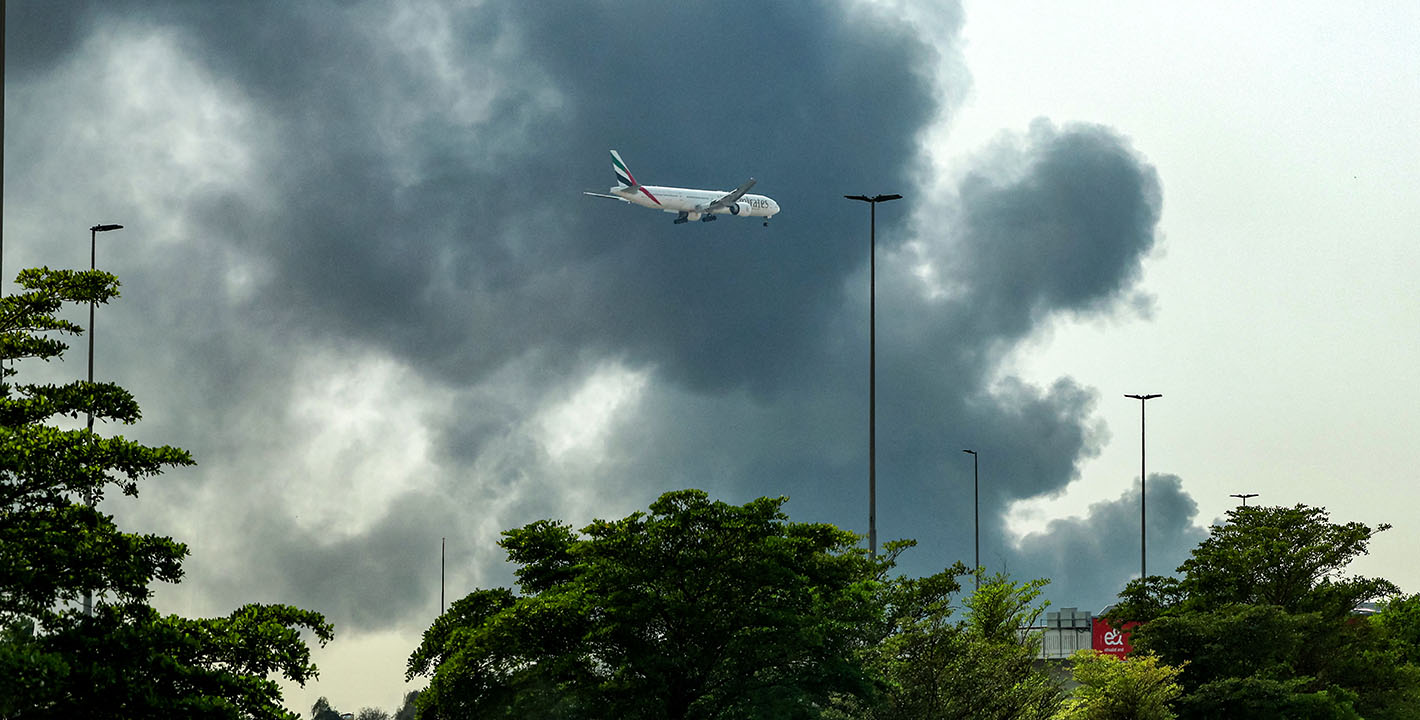
Source: Getty
In an interview, Andrew Leber discusses the impact the U.S. and Israeli war against Iran is having on Arab Gulf states.
Andrew Leber is a nonresident scholar in the Carnegie Middle East Program. He is an assistant professor at Tulane University’s Department of Political Science and the Middle East and North Africa Studies Program. His research and teaching focus on the domestic politics and international relations of the Middle East and North Africa, with a particular focus on Saudi Arabia. Diwan interviewed Leber in mid-March to get his perspective on how the U.S. and Israeli attack against Iran is playing out among the Gulf Arab states.
Michael Young: Almost three weeks into the war, what has been the impact of Iran’s decision to target surrounding Arab states on these countries’ calculations, in particular on their assessment of being part of a so-called U.S. security umbrella?
Andrew Leber: Iran has made the numerous U.S. bases in the Arab Gulf monarchies, and other forms of U.S. military presence, the basis of its public case for targeting these countries. A March 12 statement from the new supreme leader, Mujtaba Khamenei, recommended that these states “close those bases as soon as possible because they must have understood by now that the American claim of establishing security and peace was nothing but a lie.” This feeds into what we might call the “schadenfreude” critique of the Gulf states amid this conflict: that they’ve brought these attacks upon themselves because of their security choices and past agitation (at least by Saudi Arabia and the United Arab Emirates) for a U.S.-led conflict with Iran.
Notwithstanding the Gulf states’ claims to have refused that their military facilities be employed in the attacks on Iran, it is clear that the United States has demanded—and received—limited use of most such facilities for logistical support. This includes Saudi Arabia’s Prince Sultan Air Base, which hosted U.S. refueling planes and even offensive actions. For example, the U.S. or Bahraini military has fired ballistic missiles at Iran from Bahrain. There are echoes of the U.S.-led invasion of Iraq in 2003, with Saudi Arabia outwardly ruling out the use of Prince Sultan Air Base, but quietly allowing its use for supporting operations and even some offensive actions. We haven’t seen the kind of U.S. recriminations that Spain has faced after denying the use of its bases for attacks on Iran, while Defense Secretary Pete Hegseth has framed the monarchies as partners in the conflict, saying they were “going on the offense.”
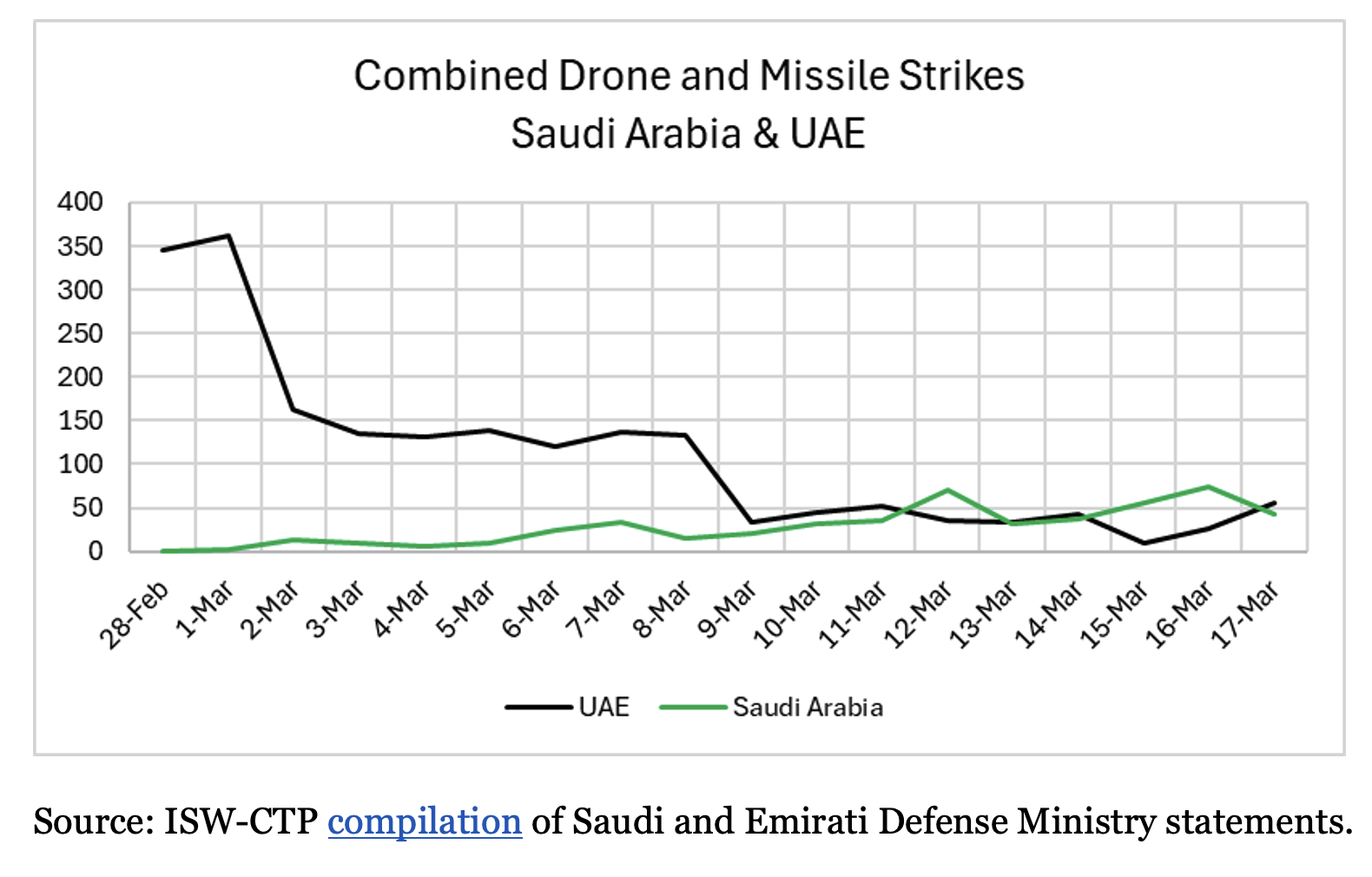
Iranian comments notwithstanding, most of the Gulf states are likely to calculate that the advantages of overt U.S. military cooperation are still worth the risks, perhaps with some debate over explicit base hosting. For one, Iran’s attacks on the Gulf monarchies thus far are as much about inflicting economic pain (to get the Gulf states to intercede with the United States) as they are about damaging U.S. military installations. Given apparent Iranian drone and missile accuracy, it’s not credible, especially to Gulf governments, to present attacks on civilian airports as misfires or accidents. Accordingly, it is a hard sell to think Iran would be concentrating fire on Israel in the absence of U.S. military bases in Gulf states.
Second, most of the Gulf states (whether Saudi Arabia, Bahrain, the United Arab Emirates, or Qatar) appear relatively happy with how their U.S.-supported air defenses have functioned so far. Finally, a major reason for Gulf states hosting U.S. bases is not to deter Iran but to deter other Gulf states from attacking them, as seen in Qatar’s ability to weather the 2017–2020 Gulf rift, or to forestall U.S. pressure on human rights, as seen in the U.S. reaction to the Arab Spring uprising in Bahrain.
The one thing that might change the calculations of Gulf rules is sustained domestic pushback against these bases. Osama bin Laden’s invectives against the U.S. troop presence in Saudi Arabia, along with a ready alternative in Qatar’s Al-Udeid Air Base, contributed to a formal U.S. withdrawal from Prince Sultan Air Base in 2003. Even in that case, however, the United States retained a smaller training mission inside Saudi Arabia and the capacity to redeploy to the Prince Sultan Air Base as needed. For now, tolerated discussion of the bases strongly endorses their presence in places such as Qatar, with some more critical views getting an airing in Kuwait and Oman.
MY: Are we beginning to see signs in Gulf capitals of a desire to urgently end the conflict, and if so, can you break down for us the attitudes among Gulf states in this regard?
AL: We’re seeing different Gulf states move in divergent directions as the conflict continues, typically reflecting their prewar positioning. Oman has been the strongest advocate for a resolution to the conflict, with Foreign Minister Badr al-Busaidi going on Face the Nation just prior to the war in a last-ditch effort to salvage nuclear talks. Even a handful of Iranian strikes on the Omani ports of Duqm and Salalah—signaling Iran’s ability to reach Gulf ports beyond the Strait of Hormuz—have left Omani officials unfazed. In an unusually frank statement to local newspaper editors, Busaidi unloaded on U.S. and Israeli attacks as a threat to regional stability and as part of a plan to undermine prospects for Palestinian statehood. While official and unofficial Qatari rhetoric has been far more critical of Iran, we might put this in the camp of pushing for (but struggling to secure) a diplomatic offramp sooner rather than later.
The United Arab Emirates’ rhetoric, meanwhile, has grown increasingly hostile toward Iran. Emirati ruler Mohammed bin Zayed warned off the country’s enemies—without specifying Iran—while other Emirati commentators have denounced Iran’s actions at length. Although Emirati businessman Khalaf Habtoor openly criticized Donald Trump and U.S. Senator Lindsey Graham for kicking off a war of choice, his social-media videos soon disappeared from his timeline, suggesting they were not in keeping with the United Arab Emirates’ preferred talking points. In a recent interview with Australian television, Minister for International Cooperation Reem al-Hashimy denounced Iran’s “unhinged” attacks on the United Arab Emirates and other Gulf states while stating that the country would be “doubling down on our friends”—namely the United States but also potentially Israel.
Saudi Arabia has thus far presented itself as holding to more of a middle position—issuing warnings to Tehran while trying to avoid getting publicly dragged into the conflict. While successive reports from the Washington Post and New York Times have portrayed Saudi leader Mohammed bin Salman as agitating for U.S. strikes against Iran, Saudi officials have insisted that it abides by the terms of the 2023 Beijing agreement that renormalized relations between the two countries. The kingdom has retreated from successive redlines rather than take military action against Iran, though Saudi officials have reportedly abandoned any hopes of a “good working relationship” with the country. While it is unlikely Saudi Arabia will opt to join the strikes, a shift in Iranian targeting toward Saudi oil fields may change that calculation. It is clear that Riyadh is either unwilling, or more likely unable, to do much to shape wartime decisionmaking in Washington.
MY: Despite the bravado in comments by senior U.S. and Israeli officials, above all President Donald Trump, are we seeing the makings of a decisive victory over Iran? Is it realistic to assume that the initial demands made of Iran, namely to end its nuclear program, severely curtain its ballistic missile arsenal, and surrender its regional alliances, will actually be implemented?
AL: It’s hard to see how this ends in a decisive U.S. and Israeli victory, despite the hopes of the war’s advocates, some of whom have veered between forecasting total victory and settling for “severely degraded” Iranian capabilities as a basis for calling it a day.
At this point, the best possible outcome would be something like the Biden administration’s “less for less” approach toward Iran—an uneasy stalemate marked by a tacit agreement between Tehran and Washington to stay out of each other’s way for a few years. Even that possibility rests on Trump caring about how the Republican Party fares as distinct from his own personal fortunes—an open question—and his ability and willingness to constrain Israeli leaders from continuing the war. Optimistic assessments focused on the scale of U.S. destruction overlook how easily even a limited number of Iranian drones can paralyze waterways and air corridors, and how the absence of a post-conflict framework contributes to the continuation of the conflict.
MY: Did the Iranian attacks against the United Arab Emirates and other Gulf countries lead to a reconciliation between Saudi Arabia and the Emiratis? In public, it would seem so, yet many of the structural reasons for their rift appear to still be in place. Your thoughts?
AL: In the early stages of the Iran war, direct communications between Mohammed bin Salman and Mohammed bin Zayed implicitly set aside the growing rift between their two countries—one that had grown quite heated among various Saudi and Emirati media surrogates. While some of this sparring has continued, commentators’ discussions of the other’s government is now more cordial than at the peak of the online invective. Gulf media narratives in traditional outlets have been heavy on cross-Gulf solidarity in the face of shared threats.
Still, there are some indications that the conflict has been set aside rather than meaningfully resolved. The UAE blocked a number of X/Twitter accounts from Emirati internet traffic at the outset of the war—including many Saudi commentators and the “breaking news” account of Saudi Arabia’s Al-Arabiya news channel. There’s every reason to think that competition between the two countries will reemerge if and when the threat from Iran appears to subside.
MY: How do you see the dynamics in the oil and gas markets in the near future, as we’ve seen fluctuating prices in the midst of this volatile situation? Who will pay the heaviest price for this in the near to medium term?
AL: The smaller Gulf states will pay the greatest immediate price, with their fossil-fuel production and shipments sharply reduced. Saudi Arabia and Oman have a greater ability to ship energy supplies out from alternative facilities along the Arabian or Red Seas (so long as the Houthis remain on the sidelines of the fighting), with higher oil prices somewhat compensating for significant reductions in the volume of shipments. While oil prices will rise worldwide (and eventually the price of everything else), the worst-hit populations will generally be those in poorer countries whose governments lack significant petroleum reserves or the financial resources to mitigate short-term economic pain.

Editor, Diwan, Senior Editor, Malcolm H. Kerr Carnegie Middle East Center
Michael Young is the editor of Diwan and a senior editor at the Malcolm H. Kerr Carnegie Middle East Center.
Recent Work
Michael Young
Michael Young
Carnegie does not take institutional positions on public policy issues; the views represented herein are those of the author(s) and do not necessarily reflect the views of Carnegie, its staff, or its trustees.
Policy discussion is ignoring that the Palestinian national project is hollowed out and apartheid is a present danger.

Nathan J. Brown
This will be the region’s most representative tournament, amid broad changes in its footballing landscape.

Issam Kayssi
As negotiations with Iran and Lebanon continue, chaos is at the heart of the Netanyahu government’s calculations.
Michael Young
Adversaries are to be degraded so deeply, that reconstitution becomes difficult or impossible.
Nathan J. Brown
Israel is encroaching on the country’s territory, while the Lebanese look askance at one another.
Issam Kayssi